For: Cats, Dogs and Horses
What is Vetivex Lactated Ringer’s Injection?
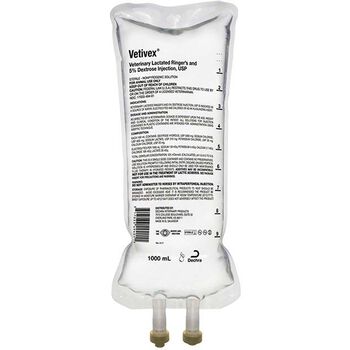
Vetivex Lactated Ringer’s Injection is a sterile, nonpyrogenic solution for fluid and electrolyte replenishment in single dose containers for parenteral (such as IV) administration. It contains no antimicrobial agents. Two color–coded, identical, dual-purpose ports can be utilized for insertion of the administration set spike or for injection of fluid additives. Vetivex Lactated Ringer’s Injection has value as a source of water and electrolytes. It is capable of inducing diuresis depending on the clinical condition of your pet. Vetivex Lactated Ringer’s Injection produces a metabolic alkalinizing effect. Lactate ions are metabolized ultimately to carbon dioxide and water, which requires the consumption of hydrogen cations.
Benefits:
- Sterile and nonpyrogenic
- Fluid and electrolyte replenishment
- Comes in single dose container
- Two color-coded, dual-purpose ports for insertions of the administration set spike or for injection of fluid additives
Cautions:
Do not administer to horses by intraperitoneal injection. Vetivex Lactated Ringer’s Injection should be used with great care, if at all, in pets with congestive heart failure, severe renal insufficiency, and in clinical states in which there exists edema with sodium retention. Vetivex Lactated Ringer’s Injection should be used with great care, if at all, in pets with hyperkalemia, severe renal failure, and in conditions in which potassium retention is present. Vetivex Lactated Ringer’s Injection should be used with great care in pets with metabolic or respiratory alkalosis. The administration of lactate ions should be done with great care in those conditions in which there is an increased level or an impaired utilization of these ions, such as severe hepatic insufficiency. In pets with diminished renal function, administration of Vetivex Lactated Ringer’s Injection may result in sodium or potassium retention. Vetivex Lactated Ringer’s Injection should not be administered simultaneously with blood through the same administration set because of the likelihood of coagulation.
Vetivex Lactated Ringer’s Injection is not for use in the treatment of lactic acidosis.
What should I discuss with my veterinarian before giving Vetivex Lactated Ringer’s Injection to my pet?
Tell your veterinarian if your pet has congestive heart failure, severe renal insufficiency or other health conditions. Let your veterinarian know if your pet has any allergies to medications.
How should Vetivex Lactated Ringer’s Injection be given?
Vetivex Lactated Ringer’s Injection should only be administered parenterally. The parenteral administration of Vetivex Lactated Ringer’s Injection can cause fluid and/or solute overloading resulting in dilution of serum electrolyte concentrations, overhydration, congested states, or pulmonary edema. The risk of dilutional states is inversely proportional to the electrolyte concentrations of the injections. The risk of solute overload causing congested states with peripheral and pulmonary edema is directly proportional to the electrolyte concentrations of the injection.
What are the potential side effects of Vetivex Lactated Ringer’s Injection?
Reactions which may occur because of the solution or the technique of administration include febrile response, infection at the site of injection, venous thrombosis or phlebitis extending from the site of injection, extravasation, and hypervolemia. If an adverse reaction does occur, discontinue the infusion, evaluate your pet, institute appropriate therapeutic countermeasures, and save the remainder of the fluid for examination if deemed necessary.
What happens if I miss giving a dose of Vetivex Lactated Ringer’s Injection?
Contact your veterinarian immediately.
What happens if I overdose my pet on Vetivex Lactated Ringer’s Injection?
In an event of overhydration or solute overload, re-evaluate your pet and institute appropriate corrective measures. Excess administration may result in metabolic alkalosis.
What should I avoid while giving Vetivex Lactated Ringer’s Injection to my pet?
Clinical evaluation and periodic laboratory determinations are necessary to monitor changes in fluid balance, electrolyte concentrations, and acid base balance during prolonged parenteral therapy or whenever the condition of your pet warrants such evaluation. Veterinary Lactated Ringer’s Injection must be used with caution. Excess administration may result in metabolic alkalosis.
What other drugs will affect Vetivex Lactated Ringer’s Injection?
Caution must be exercised in the administration of Veterinary Lactated Ringer’s Injection to pets receiving corticosteroids or corticotropin. Additives may be incompatible. Complete information is not available. Those additives known to be incompatible should not be used. If, in the informed judgment of your veterinarian, it is deemed advisable to introduce additives, use aseptic technique. Mix thoroughly when additives have been introduced. Do not store solutions containing additives. Discard unused portion.