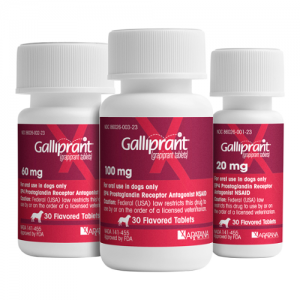
Brand Name: Galliprant
Generic Name: Grapiprant
For: Dogs (9+ months of age, weighing 8+ lbs)
What is Galliprant?
Galliprant (grapiprant tablets) is a non-steroidal, anti-inflammatory drug for the control of pain and inflammation due to osteoarthritis in dogs. It is specifically formulated to safely treat canine osteoarthritis (OA) from its earliest diagnosed stages. Dogs as young as 9 months of age have been safely treated with Galliprant (grapiprant tablets) for early stages of osteoarthritis. Galliprant (grapiprant tablets) is a new class of anti-inflammatory that targets pain and helps dogs with OA remain comfortable and active. It specifically blocks the primary mediator of canine OA pain and inflammation (EP4 receptor) while reducing the impact on gastrointestinal, kidney, and liver homeostasis. The pork liver-flavored tablets are scored for easy administration.
Benefits:
- Indicated for the treatment of pain and inflammation associated with canine osteoarthritis
- Safe and effective for dogs as young as 9 months, weighing at least 8 lbs
- Targets canine OA pain and inflammation while reducing the impact on GI, kidney, and liver homeostasis
- Pork liver-flavored, scored tablets make administration easy
- Helps dogs with osteoarthritis remain active and pain-free
Cautions:
Galliprant (grapiprant tablets) is for use in dogs 9 months of age or older, weighing 8 lbs or more only. Do not use in cats. Galliprant (grapiprant tablets) are not for use in humans. Keep this and all medications out of reach of children and pets. Consult a physician in case of accidental ingestion by humans. Store Galliprant (grapiprant tablets) out of reach of dogs and other pets in a secured location in order to prevent accidental ingestion or overdose.
What is the most important thing I should know about Galliprant (grapiprant tablets)?
Galliprant (grapiprant tablets) is used in dogs for the treatment of pain and inflammation from osteoarthritis (OA). It is a first-in-class non-COX-inhibiting prostaglandin receptor antagonist. Galliprant (grapiprant tablets) is prescription (RX) medication. It is available in 20 mg, 60 mg, and 100 mg strength tablets. The safe use of Galliprant (grapiprant tablets) has not been evaluated in dogs younger than 9 months of age and less than 8 lbs in weight, dogs used for breeding, or in pregnant or lactating dogs. Galliprant (grapiprant tablets) should not be used in dogs that have a hypersensitivity to grapiprant. If Galliprant (grapiprant tablets) is used long term, appropriate monitoring is recommended. Concurrent use with other anti-inflammatory drugs has not been studied. Concomitant use of Galliprant (grapiprant tablets) with other anti-inflammatory drugs, such as COX-inhibiting NSAIDs or corticosteroids, should be avoided. If additional pain medication is needed after a daily dose of Galliprant (grapiprant tablets), a non-NSAID/non-corticosteroid class of analgesic may be necessary. Concomitant use of protein-bound drugs with Galliprant (grapiprant tablets) has not been studied. Commonly used protein-bound drugs include cardiac, anticonvulsant and behavioral medications. Drug compatibility should be monitored in patients requiring adjunctive therapy. Consider appropriate washout times when switching from one anti-inflammatory to another or when switching from corticosteroids or COX-inhibiting NSAIDs to Galliprant (grapiprant tablets) use. The use of Galliprant (grapiprant tablets) in dogs with cardiac disease has not been studied. It is not known whether dogs with a history of hypersensitivity to sulfonamide drugs will exhibit hypersensitivity to Galliprant (grapiprant tablets). Galliprant (grapiprant tablets) is a methylbenzenesulfonamide. See Galliprant label for complete safety information.
What are the potential side effects of of Galliprant?
Adverse reactions in dogs receiving Galliprant (grapiprant tablets) may include vomiting, diarrhea, decreased appetite, and tiredness.
What happens if I miss giving a dose of Galliprant?
If you miss giving a dose of Galliprant (grapiprant tablets), contact your veterinarian. Do not double dose.
What happens if I overdose my pet on Galliprant?
Contact your veterinarian or veterinary emergency room.
What should I avoid while giving Galliprant to my pet? & What other drugs will affect?
Avoid giving other medications to your pet while on Galliprant unless approved by your veterinarian. Do not give to cats or dogs weighing less than 8 lbs. & Galliprant should not be given with other non-steroidal anti-inflammatory drugs (NSAIDs) or corticosteroids (for example, aspirin, carprofen, meloxicam and prednisone).