Brand Name: Atopica
Generic Name: Cyclosporine
For: Dogs (6+ months of age, weighing 4+ lbs) and Cats (6+ months of age, weighing 3+ lbs)
What is Atopica (cyclosporine)?
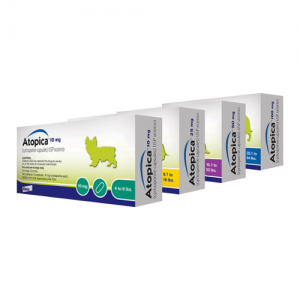
Atopica is an FDA approved immunosuppressant used to treat atopic dermatitis for dogs and cats. Atopica comes in separate boxes and formulation for each type of pet.
Atopica for Dogs (given as an oral capsule) is used to treat atopic dermatitis (commonly called skin allergies) in dogs. Signs of skin allergies include itching, scratching, licking, gnawing, chewing, skin infections, hair loss, terrible odor, and sleepless nights.
Similarly, Atopica for Cats (given as an oral solution) is used to control feline allergic dermatitis (allergic skin disease) as seen as broken skin, including facial and neck (miliary dermatitis, eosinophilic plaques, and self-induced alopecia). Signs of allergic skin disease include itching, chewing, licking, skin lesions and hair loss. Some cats may develop lesions that may even appear on the face and neck.
Please keep in mind that the generic form of Atopica, cyclosporine, will be specifically tailored to your pets needs regardless of type or breed.
Benefits:
- Significantly reduces itching and skin lesions
- Proven effective in most dogs and cats
- Safe to use over long periods without the serious side effects usually associated with steroids
- Controls feline allergic dermatitis
- Since Atopica for cats is given in an oral solution, it comes in an easy-to-administer liquid formulation and includes an oral syringe
- Most cats find the taste acceptable, but can be mixed with food for picky eaters
- *This item can be purchased as the brand or as the compounded generic form.*
How does Atopica work?
Atopica targets the immune cells involved in the allergic reaction. You usually only administer one dose a day to control symptoms, but many dogs can be effectively controlled with every-other-day or twice-weekly dosing. Atopica for Cats (oral solution) works by calming and soothing allergic skin conditions such as feline allergic dermatitis. It contains cyclosporine which stops the itching by blocking white blood cells from organizing and responding to infection. The oral solution is usually very well tolerated by cats and becomes easily absorbed in the intestinal tract.
Cautions:
Not for human use. Keep this and all drugs out of the reach of children.
Atopica for Dogs is for use in dogs only. Wear gloves during administration. Capsules should not be broken or opened. Wash hands after administration. In case of accidental ingestion, seek medical advice immediately and provide the package insert or the label to the physician. There are many possible drug interactions. Be sure to tell your veterinarian what other medications your pet is currently using. Give Atopica at least one hour before food or 2 hours after food.
Atopica for Cats is for use in cats only. Do not rinse or clean the oral dosing syringe between uses. Please see the directions inside the Atopica for Cats box to ensure proper technique. Do not give to cats that have a history of cancer, feline leukemia or feline immunodeficiency virus or that are sensitive to cyclosporine. It is an immunosuppressant that may increase susceptibility to infection, development or neoplasia, and decrease response to vaccination. Use with caution in cats with diabetes mellitus or renal insufficiency, and with drugs that affect the P-450 enzyme system. For complete safety information, see the product label.
What is the most important thing I should know about Atopica for Dogs?
Atopica for Dogs: Notify your veterinarian immediately if your pet develops fever (over 103°), painful urination, tiredness, sneezing, coughing, or runny nose. These symptoms could be early signs of dangerous side effects. Don’t use in dogs with a history of neoplasia, with a hypersensitivity to cyclosporine, or in reproducing dogs. Use with caution in dogs with diabetes mellitus or renal insufficiency, and with drugs that affect the P-450 pathway. Killed vaccines are recommended. Atopica is a systemic immunosuppressant that may increase susceptibility to infection and development of neoplasia. See product label for complete safety information.
Atopica for Cats (cyclosporine modified) is an immunosuppressant available by prescription. Atopica for Cats is FDA approved for use in the treatment of feline allergic dermatitis in cats at least 6 months of age and weighing at least 3 pounds. Atopica for Cats is available as 5ml and 17ml oral solutions and comes with an oral syringe. The usual dose of Atopica for Cats is 3.2 mg/lb (7 mg/kg) orally 1 time a day for 4-6 weeks. Following this, the dose may be tapered to every other day or twice weekly as needed to maintain the therapeutic effect. Dosing of the liquid formulation is accomplished by a syringe that is marked with weight bands for easy dosing.
What should I discuss with my veterinarian before giving Atopica for both Dogs and Cats?
Tell your veterinarian if your pet has liver disease, kidney disease, cancer, high blood pressure, a viral, bacterial or fungal infection, or any other serious or chronic condition. Tell your veterinarian if your pet is pregnant or lactating, and if you plan to breed your pet.
What are the potential side effects of Atopica for Dogs?
Atopica for Dogs: If any of the following serious side effects occur, stop giving Atopica for Dogs to your pet and seek emergency veterinary medical attention: an allergic reaction (difficulty breathing, swelling of the lips, tongue or face, and hives). Gastrointestinal problems and gingival hyperplasia may occur at the initial dose. Other less serious side effects may occur. Continue giving Atopica for Dogs and talk to your veterinarian if your pet develops vomiting, soft stools or diarrhea, muscle cramps, muscle weakness, loss of appetite, and change of hair coat. Other side effects may occur. Talk to your veterinarian about any side effect that seems unusual or bothersome to your pet.
Atopica for Cats: If any of the following serious side effects occur, stop giving Atopica for Cats and seek emergency veterinary medical attention: an allergic reaction (difficulty breathing, swelling of the lips, tongue or face, and hives). Other less serious side effects may occur. Continue giving Atopica for Cats and talk to your veterinarian if your pet develops vomiting, soft stools or diarrhea, muscle cramps, muscle weakness, weight loss, loss of appetite, and change of hair coat. Persistent, progressive weight loss may result in hepatic lipidosis; monitoring of body weight is recommended. Other side effects may occur. Talk to your veterinarian about any side effect that seems unusual or bothersome to your pet.
What happens if I miss giving a dose of Atopica to my pet?
For both Dogs and Cats: Give the missed dose as soon as you remember. If it is almost time for the next dose, skip the dose you missed and give the next regularly scheduled dose. Do not give a double dose unless otherwise directed by your veterinarian.
What should I avoid while giving Atopica to my pet?
The safe use in breeding, pregnant or lactating pets has not been determined. Do not use Atopica for Dogs in pets with known allergy to the medication. The drug should not be used in pets with kidney disease, stomach ulcers, and certain blood disorders. Prolonged use of Atopica can result in bacterial or fungal infection related to a decreased effect of the immune system. For Cats: During treatment, cats should avoid exposure to toxoplasma gondii.
What other drugs will affect Atopica?
Atopica for Dogs: Tell your veterinarian what medications your pet is currently using and any new products, including herbal remedies you may start to give. Drug/drug interactions could cause a decrease in effectiveness or an increase in side effects of either Atopica or the other medication being given. Examples of medications that may cause drug/drug interactions are: SMZ-TMP (Bactrim, Septra), gentamicin, etodolac (EtoGesic), piroxicam (Feldene), ketoconazole (Nizoral), cimetidine (Tagamet), ranitidine (Zantac), itraconazole (Sporanox), methylprednisolone (Medrol), erythromycin, Allopurinol (Zyloprim), metoclopramide (Reglan), prednisolone, digoxin (Lanoxin), or any type of vaccination.
Atopica for Cats: There are many drug/drug interactions that occur when taking Atopica for Cats. Tell your veterinarian what medications your pet is currently using and any new products, including herbal remedies you may start to give. Drug/drug interactions could cause a decrease in effectiveness or an increase in side effects of either Atopica for Cats or the other medication being given. Examples of medications that may cause drug/drug interactions are: SMZ-TMP (Bactrim, Septra), gentamicin, etodolac (EtoGesic), piroxicam (Feldene), ketoconazole (Nizoral), cimetidine (Tagamet), ranitidine (Zantac), itraconazole (Sporanox), methylprednisolone (Medrol), erythromycin, Allopurinol (Zyloprim), metoclopramide (Reglan), prednisolone, digoxin (Lanoxin), any type of vaccination.
What happens if I overdose my pet:
Seek emergency veterinary medical treatment.